
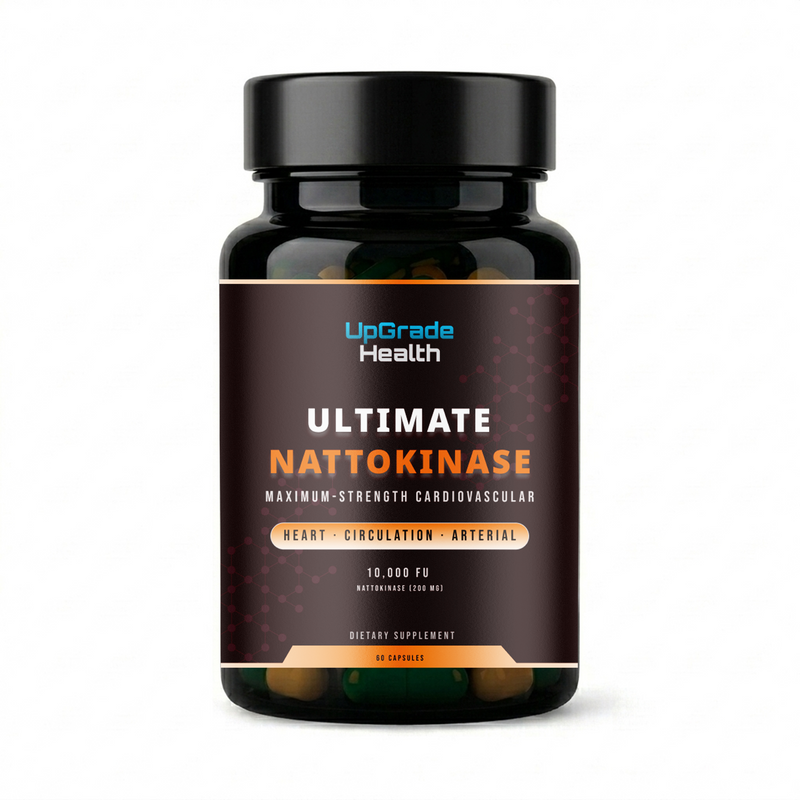


Ultimate Nattokinase — The 10,000 FU Clinical Dose For The Cardiovascular System Most Adults Are Quietly Losing.
Nattokinase is a fibrinolytic enzyme isolated from natto — the fermented soybean dish eaten in Japan for over a thousand years. In 1980, Japanese researcher Dr. Hiroyuki Sumi tested 173 traditional foods looking for compounds that dissolved blood clots. Nattokinase was the only one that did it powerfully. Since then, more than two decades of clinical research have shown it can reduce arterial plaque, lower blood pressure, and improve fibrinolytic activity — the body's natural ability to keep blood vessels clear.
Our 10,000 FU per capsule is five times the mass-market dose — and the level used in the Chen 2022 trial that demonstrated 36% reduction in carotid arterial plaque over 26 weeks.
🛡️ The 60-Day Guarantee Sub: Don't feel a meaningful shift in circulation and cardiovascular markers within 60 days? Hassle-free refund. No return required.
Ultimate Nattokinase · 10,000 FU · 60 capsules
"Cardiologist watched my carotid plaque shrink on the next ultrasound. He's recommending it to other patients now."
"Blood pressure dropped from 142/88 to 124/78 in eight weeks. No medication change. Just this."
"Cold hands and feet for ten years. Three weeks in and they're warm again. My wife noticed before I did."
"Climbed a mountain at altitude last month. At 58. Wouldn't have made it past the first hour two years ago."
Most nattokinase on the market is dosed at 2,000 FU and contains vitamin K2 that interacts with blood thinners. Here's how Ultimate Nattokinase is built differently.
10,000 FU — Five Times The Mass-Market Dose.
Most nattokinase on shelves is dosed at 2,000 FU — a token amount chosen to keep ingredient costs low while letting the label say "nattokinase inside." The clinical research that demonstrates plaque reduction and blood pressure improvement uses 10,000-10,800 FU per dose. We dose at the clinical level. Period.
Vitamin K2-Free — Safer For Anyone On Blood Thinners.
Some nattokinase products bundle vitamin K2 because it's a natural component of natto fermentation. The problem: K2 directly interacts with warfarin and reduces its anticoagulant effect — dangerous for anyone on blood thinners. We strip the K2 specifically so this molecule is safe for the cardiovascular patients who often need it most. (Always consult your physician before combining with anticoagulants.)
Enteric-Coated Capsule — Survives Stomach Acid Intact.
Nattokinase is a protein enzyme — exactly the kind of molecule your stomach acid is built to break down. Without an enteric coating, most of the dose is degraded before it reaches absorption sites in the upper small intestine. Our enteric coating dissolves at intestinal pH, not gastric pH — the dose arrives intact at the cells that take it up.
Bacillus subtilis natto — The Original Strain.
Nattokinase quality depends on the strain that ferments the soybean substrate. The original Bacillus subtilis natto strain — used in traditional Japanese natto for centuries — produces the highest enzyme yield with the cleanest profile. Generic Bacillus strains produce variable enzyme activity batch to batch. We source from manufacturers using the original strain only.
Nattokinase (Bacillus subtilis natto Extract)
10,000 FU per capsuleA serine protease enzyme isolated from fermented soybean that directly breaks down fibrin — the protein scaffolding inside blood clots and arterial plaque. Fujita 1995 demonstrated nattokinase has roughly 4× the fibrinolytic potency of plasmin (your body's own clot-dissolving enzyme). Twenty years of clinical research on healthy adults and cardiovascular patients support its use for fibrinolytic activity, blood pressure modulation, and arterial plaque reduction.
Nothing Else.
No K2 · no fillers · no proprietary blendsJust the enzyme. No vitamin K2 (which interacts with blood thinners). No proprietary blends or hidden fillers. The enteric capsule shell and the inert excipients required to keep capsule fill consistent — that's the complete formula. We disclose every milligram. The simple formulation is what makes this product safe to combine with the cardiovascular protocols our customers are often already on.
The Silent Cardiovascular Decline
Heart Disease Is The #1 Cause Of Death — And It Builds For Decades Before You Feel It.
Arterial plaque starts forming in your twenties. Blood becomes "stickier" decade by decade as fibrin accumulates. Microvascular flow declines silently. By the time most adults notice their cardiovascular system is in trouble — chest pain, shortness of breath, an event — the disease has been progressing for thirty years. Cardiovascular decline is not a sudden catastrophe. It's a slow drift you can address while it's still reversible.
Interactive · Drag the slider to see your numbers
Your cardiovascular markers by age
Arterial wall flexibility declines roughly 0.5–1% per year after thirty. Stiffer arteries mean higher systolic pressure and reduced diastolic perfusion of the heart muscle itself.
Endogenous fibrinolytic activity declines with age while clotting tendency rises. The result: fibrin deposits accumulate in microvasculature, reducing tissue perfusion across organs.
Capillary density in muscle, brain, and skin declines 20–30% from your twenties to your sixties. Less microvascular flow means less oxygen delivery — at every level of effort.
Plaque Forms Before You Turn 30.
The Bogalusa Heart Study followed children and adolescents for decades. Atherosclerotic plaque was already detectable in coronary arteries of healthy young adults in their twenties. By forty, virtually every adult has measurable arterial plaque. The disease starts decades before any symptom appears.
Fibrinolytic Activity Drops With Age.
Your body produces plasmin — its natural fibrin-dissolving enzyme — at peak rates in your twenties. By sixty, plasmin output has declined roughly 30%. Meanwhile fibrin formation increases due to chronic inflammation and metabolic disease. The balance tips toward clot formation, year over year.
Blood Pressure Climbs Quietly.
Average systolic blood pressure rises about 1 mmHg per year after thirty. Most people don't track it until it crosses 140. By that point, the arterial walls have been remodeling under elevated pressure for years — the structural change is harder to reverse than the number on the cuff suggests.
Microvascular Flow Declines Across Organs.
Your brain, kidneys, heart muscle, and skin all depend on capillary networks for oxygen and nutrient delivery. Fibrin accumulation, endothelial dysfunction, and arterial stiffening all reduce microvascular flow. Cognitive decline, reduced exercise capacity, kidney function decline, and skin aging are all downstream of microvascular failure.
Most "Heart Health" Supplements Don't Address Fibrin.
Fish oil, magnesium, CoQ10 — all support cardiovascular health, but none directly target fibrin accumulation. The clinical evidence for actually reducing arterial plaque sits with very few molecules. Nattokinase at clinical dose is one of them. The Chen 2022 study showed 36% plaque reduction in 26 weeks at 10,800 FU. That's the rare supplement evidence that actually moves a structural marker.
A 1980 Discovery From Tokyo
The Enzyme Japanese Researchers Found After Testing 173 Traditional Foods.
In 1980, Dr. Hiroyuki Sumi at Chicago University Medical School tested 173 traditional foods looking for compounds with fibrinolytic activity — the ability to dissolve blood clots. Nattokinase, the enzyme produced by Bacillus subtilis natto fermenting soybeans, was the only one that worked powerfully. Since then, the Nagata 2017 Takayama study followed 29,079 Japanese adults for 16 years and found those who ate natto regularly had 43% lower cardiovascular mortality. The Chen 2022 trial demonstrated 36% reduction in carotid arterial plaque at 10,800 FU. The molecule works. Most products just don't dose it correctly.
BY THE NUMBERS
What 40 Years Of Cardiovascular Research Shows.
From the original 1980 discovery to the largest published cohort study — nattokinase has the cleanest evidence in cardiovascular supplementation.
The Honest Timeline
What you'll actually feel — week by week.
Cardiovascular changes are slow and structural. Most subjective shifts happen at the periphery — circulation, hands and feet, exercise tolerance. The deeper benefits build over months. Here's the real pattern.
Subtle peripheral warming.
First week: most users notice nothing dramatic. Some report subtle shifts in extremity warmth — hands and feet running slightly warmer, especially in cold environments. This corresponds to improved peripheral microvascular flow as fibrin clearance begins. The molecule is establishing baseline activity.
Exercise endurance shifts.
By week 2, many users notice exercise tolerance improving — workouts feel less heavy, recovery between sets is faster, peripheral fatigue takes longer to set in. Subtle but real. Improved fibrinolysis means better oxygen delivery to working muscle. Some report easier breathing during cardio.
Blood pressure starts moving.
Studies show BP-lowering effects emerging at 4-8 weeks of consistent use. If you track BP at home, this is the window where 5-7 mmHg shifts in systolic typically appear. Cognition often improves alongside — better cerebral microvascular flow translates to slightly clearer thinking and reduced afternoon mental fatigue.
Structural cardiovascular markers shift.
The published plaque-reduction studies (Chen 2022) ran 26 weeks. Structural changes — carotid intima-media thickness, arterial stiffness, endothelial function — show meaningful shifts at 3-6 months. This is when cardiologist-tracked metrics tend to update on bloodwork and imaging. The molecule is working at this depth, even if subjective sensation has stabilized.
Why Conventional "Heart Health" Falls Short
Most Cardiovascular Supplements Help. Few Actually Reduce Plaque.
Fish oil, magnesium, CoQ10 — all support cardiovascular health in different ways, but none directly target the fibrin scaffolding inside arterial plaque. The clinical evidence for structural plaque reduction is rare. Nattokinase at clinical dose is on the very short list.
Why Most Nattokinase Products Underdose
The Difference Between A Supplement That Reduces Plaque And One That Doesn't Comes Down To One Number: FU.
Fibrinolytic Units. The clinical trials use 10,000-10,800 FU. Most products on shelves use 2,000 FU. Below 10,000 FU, the published evidence for arterial plaque reduction effectively disappears. The dose is the difference.
Honest gating
Who Ultimate Nattokinase Is For — And Who It Absolutely Isn't.
We'd rather lose your sale than have you on a fibrinolytic enzyme that interacts with a blood thinner you didn't disclose. Read the second list carefully.
This is built for
This isn't for
Build your cardiovascular protocol
Nattokinase is the structural intervention. These compound the foundation.
Each adds a different vector to cardiovascular health. Pick based on your reason for being on this page.
Immortalis
Cellular pair · for vascular cell regulation
Add if you want to support the cellular regulators that govern endothelial function and vascular repair. Nattokinase clears fibrin at the plumbing level; Immortalis supports the cellular machinery that maintains vascular health. Two complementary angles on cardiovascular longevity.
View Immortalis →Methylene Blue Drops
Energy pair · for cardiac mitochondrial support
Add if you want to support the mitochondrial energy production that powers the heart muscle itself — which has the highest mitochondrial density of any tissue. Pairs with nattokinase for both vascular and cardiac muscle work.
View Methylene Blue Drops →BPC-157 Capsules
Repair pair · for vessel and tissue regeneration
Add if you want to support endothelial repair and microvascular regeneration. BPC-157's documented angiogenic activity (new blood vessel formation) complements nattokinase's fibrin clearance — one builds new vessels, the other clears existing ones.
View BPC-157 →Your Purchase Is Protected By A 60-Day Money-Back Guarantee.
Every Batch Lab Tested
Each batch is independently tested for FU activity, identity, heavy metals, and microbial safety. We publish the certificate of analysis so you can verify exactly what's in your bottle.
60-Day Risk-Free Trial
Cardiovascular changes are structural and slow. Give Ultimate Nattokinase 60 days of consistent use. If you don't notice peripheral circulation improvements or exercise tolerance shifts, contact us for a full, hassle-free refund.
Hassle-Free Refunds
No restocking fees. No long forms. No surveys. Email us, we process the refund. We'd rather lose the sale than have you on a product that didn't deliver for your body.
It works. Hear from real people.
"Cardiologist watched my carotid plaque shrink."
Diagnosed with moderate carotid plaque at 60. My cardiologist suggested statins; I asked for six months to try lifestyle plus nattokinase first. Eight months later, the follow-up ultrasound showed measurable plaque reduction. He was so impressed he started recommending it to other patients. Doses matter — I went straight to 10,000 FU based on the Chen study.
"Blood pressure dropped 18 points in eight weeks."
Pre-hypertensive for a decade. Diet, exercise, magnesium, CoQ10 — nothing moved the number much. Eight weeks on Ultimate Nattokinase and I went from 142/88 to 124/78. Consistent home readings. Same diet, same exercise. My PCP asked what changed and I showed her the bottle. She approved continuing.
"Cold hands and feet — gone in three weeks."
Raynaud's-like cold hands and feet for ten years. Couldn't sleep without socks. Three weeks into 10,000 FU twice a day and my extremities started running warm again. My wife noticed the difference before I did — she stopped recoiling when I touched her at night. The microvascular thing is real.
"Climbed at altitude at 58 — wouldn't have made it two years ago."
Family history of cardiovascular disease, working hard to age well. Six months on this and I just summited a 12,000-ft peak with my son. Held my own. Two years ago I was getting winded climbing stairs. Whatever this is doing to my microvasculature, it shows up at altitude where oxygen delivery actually matters.
Note · Sample reviews shown for layout. Real verified customer reviews will replace these after launch.
Frequently asked questions
The published clinical trials that demonstrate plaque reduction and meaningful BP modulation use 10,000-10,800 FU. Below that, the evidence for structural cardiovascular benefit drops sharply. 2,000 FU is the legacy Japanese serving size from natto consumption — not a clinical-research dose. Mass-market brands use 2,000 FU because it's cheaper, not because it's effective.
K2 IS valuable for cardiovascular health independently — but it's specifically problematic when bundled with nattokinase for one reason: K2 directly counteracts warfarin (a common anticoagulant). Many people who benefit most from nattokinase are also on blood thinners. Bundling K2 makes the product unsafe for that population. We split the products: nattokinase here, K2 separately if you need it. Customers who aren't on anticoagulants can stack K2 separately.
Subjective effects (peripheral warmth, exercise tolerance) typically emerge in weeks 1-3. Blood pressure shifts, when present, show up at 4-8 weeks. Structural cardiovascular changes (plaque, intima-media thickness) take 3-6 months — these are tracked through imaging, not subjective sensation. Don't expect immediate results. Expect a slow structural recalibration.
Yes — nattokinase and statins work through completely different mechanisms (statins lower LDL synthesis; nattokinase dissolves existing fibrin). They're often combined in cardiovascular protocols under physician supervision. No known harmful interactions. Many cardiologists are familiar with nattokinase and have no objection to its addition. Always confirm with your prescribing physician.
Yes. Discontinue nattokinase at least 14 days before any planned surgery — its fibrinolytic activity can increase intraoperative bleeding risk. Resume only after your surgeon clears it post-op. Same caution applies before dental procedures, colonoscopies, or any invasive procedure.
Studies running 6 months to over a year show no significant adverse events at clinical doses in healthy adults. The Nagata 2017 cohort followed natto consumers (effective long-term nattokinase exposure) for 16 years and found 43% LOWER cardiovascular mortality versus non-consumers. Long-term safety profile is unusually robust for a supplement molecule. Cycling is optional — many users run continuous.
We offer a 60-day, no-questions-asked money-back guarantee. Use the bottle. If you don't notice a meaningful difference in energy, sleep, or metabolic baseline, email us with your order number and we'll refund you in full. No restocking fees, no surveys, no runaround.