
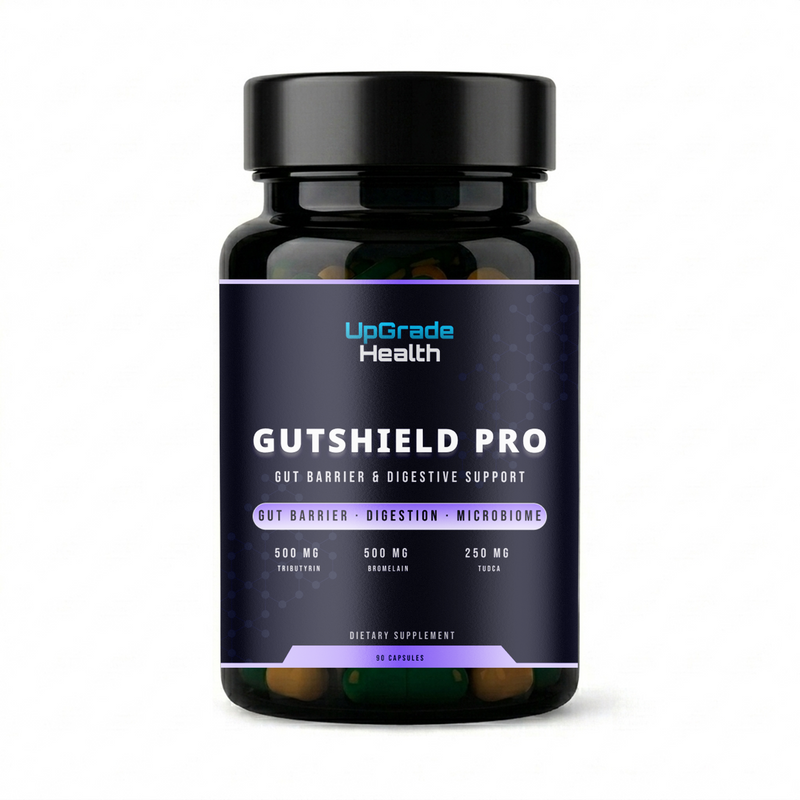


GutShield Pro — The 5-Ingredient Gut Barrier Protocol That Feeds, Soothes, And Repairs The Lining At Once.
Your gut barrier is a single cell layer — thinner than tissue paper — separating your bloodstream from the contents of your gut. When stress, NSAIDs, alcohol, and modern food break it down, the result is systemic inflammation, brain fog, and food sensitivities. GutShield Pro pairs butyrate, a digestive enzyme, a bile-flow agent, and two repair peptides to feed the lining, calm it, and help rebuild the barrier.
A complete 5-ingredient stack: Tributyrin (500 mg butyrate source) + Bromelain (500 mg, 2,400 GDU) + TUDCA (250 mg) + BPC-157 Arginate (1,000 mcg) + KPV (500 mcg). Full-label transparency — every dose listed.
🛡️ The 60-Day Guarantee Sub: Don't feel the energy and clarity shift within 60 days? Hassle-free refund. No return required.
GutShield Pro · 5-Ingredient Gut Stack · 90 caps
"Food sensitivities after years of antibiotics — now I eat anything."
"My bloating dropped by half in 5 weeks."
"On ibuprofen for years for my back. Finally found something that settles my gut."
"Chronic stress wrecked my stomach. 8 weeks in and digestion is normal again."
Most gut products use one ingredient at a token dose. Here's how GutShield Pro's 5-ingredient stack is built differently.
Five Ingredients. Five Mechanisms. One Capsule.
Most gut products give you one mechanism. GutShield Pro stacks five: Tributyrin feeds the lining with butyrate, Bromelain supports digestion and calms inflammation, TUDCA supports bile flow and the liver-gut axis, BPC-157 Arginate adds repair signaling, and KPV adds anti-inflammatory peptide support.
Published Research Levels Across All Five.
We dose each ingredient at the level where published research shows meaningful effects. Bromelain and TUDCA have human data in their lanes; BPC-157 and KPV are primarily preclinical — we're honest about both.
BPC-157 + KPV — Repair + Anti-Inflammatory.
BPC-157 Arginate (oral-stable form) supports gut lining, tight junctions, and gut inflammation in preclinical research. KPV is a tripeptide fragment of alpha-MSH studied preclinically for anti-inflammatory activity in gut and skin. Both are primarily preclinical — included for their mechanisms alongside the better-studied Bromelain and TUDCA.
Honest Evidence: Human Data Where It Exists, Preclinical Where It Doesn't.
Bromelain has well-documented anti-inflammatory and digestive activity in human research. TUDCA has strong human data in liver/cholestatic contexts. BPC-157 and KPV are primarily preclinical — promising mechanisms, not yet proven in human gut trials. We include them alongside the better-studied ingredients.
Tributyrin
500 mg per servingA stable, slow-release source of butyrate — the preferred fuel for colon-lining cells. Tributyrin delivers butyrate further downstream in the GI tract than sodium butyrate, supporting the lining's energy supply and the microbiome. Supplied on a powder carrier for stable encapsulation.
Bromelain + TUDCA
500 mg Bromelain (2,400 GDU) + 250 mg TUDCABromelain is a proteolytic enzyme complex from pineapple that supports protein digestion and has well-documented anti-inflammatory activity in human research. TUDCA (Tauroursodeoxycholic acid) supports bile flow, the liver-gut axis, and buffers cellular (ER) stress — strongest human evidence in liver/cholestatic contexts.
BPC-157 Arginate + KPV
1,000 mcg BPC-157 + 500 mcg KPVBPC-157 Arginate (oral-stable form) — the same gut-repair peptide as our standalone capsule at double the dose. Preclinical support for the intestinal lining, tight junctions, and gut inflammation. KPV is a lysine-proline-valine alpha-MSH fragment studied preclinically for anti-inflammatory activity in gut and skin.
The barrier crisis
Why 'Leaky Gut' Isn't A Wellness Fad — And The Structural Damage Most Doctors Can't Even Test For.
The term 'leaky gut' gets dismissed in some circles. The science — intestinal permeability — does not. When that single cell layer is damaged, food particles, bacterial fragments, and inflammatory signals leak into circulation and your immune system reacts.
Interactive · Drag the slider to see your numbers
Your gut barrier integrity by age
Tight junction proteins — the seals between gut epithelial cells — degrade with age, NSAID use, and chronic inflammation. By midlife, the average adult shows measurably increased intestinal permeability versus their twenties baseline.
The mucin layer that physically coats your gut epithelial cells thins with age, antibiotic exposure, and low-fiber diets. Less mucin means more direct contact between gut bacteria and the epithelial wall — more inflammation, more barrier stress.
Your gut lining cells normally replace themselves every 3-5 days. With chronic inflammation and nutrient deficiency, this turnover slows. Older, dysfunctional cells stay in place longer. Repair lags behind damage.
The Gut Lining Runs Out Of Fuel.
Colon-lining cells prefer butyrate — a short-chain fatty acid made by gut bacteria — as fuel. Low-fiber diets, antibiotics, and dysbiosis cut butyrate supply, and an under-fueled lining can't hold a tight barrier.
NSAIDs Damage The Mucosal Layer.
Regular ibuprofen, naproxen, or aspirin actively damages the gut barrier; research links NSAID use to measurable increases in intestinal permeability.
Bile Flow And The Liver-Gut Axis Stall.
Healthy bile flow supports the liver-gut axis and gut-lining integrity. Sluggish bile and cellular stress contribute to inflammation and poor barrier function.
Food Sensitivities Aren't Random.
New sensitivities often reflect food particles leaking past a damaged barrier — your immune system treating them as invaders.
Systemic Inflammation Follows Gut Inflammation.
Autoimmune flare-ups, skin issues, joint pain, brain fog, and fatigue often trace upstream to gut-barrier inflammation.
The seal
Five Ingredients. Five Mechanisms. One Sealed Barrier.
Five specific ingredients, each with a distinct mechanism — feed, digest, support bile, repair, and calm.
BY THE NUMBERS
What 30 Years Of Gut Barrier Research Shows.
Five compounds with independent peer-reviewed evidence — stacked into one capsule.
The Honest Timeline
What you'll actually feel — week by week.
Gut barrier repair is structural. Symptoms shift in a predictable order: digestive comfort first, food sensitivities later, autoimmune and systemic markers latest. Here's the real pattern.
Bloating eases. Digestion quiets.
Slippery elm and DGL's soothing effects often show up first — within days, post-meal bloating tends to drop, digestive discomfort calms, and "gut noise" decreases. The mucilaginous coating and inflammation modulation are working before the structural repair compounds have built up. Some users notice better sleep alongside as gut-driven inflammation backs off.
Post-meal symptoms back off.
By weeks 2-3, the L-glutamine and zinc carnosine cellular repair effects are accumulating. Post-meal fatigue (the "food coma" feeling that's actually inflammation) tends to fade. Acid reflux often calms. Stool consistency typically normalizes. The gut feels less reactive — meals stop being events your body has to recover from.
Food sensitivities start releasing.
Tight junction repair takes weeks to translate to functional permeability changes. By week 4-6, foods that have been triggering reactions often start being tolerated again. The list of "things I can't eat" begins to shrink. This is when most users say "I can have eggs again" or "dairy stopped bothering me." The barrier is genuinely sealing.
Systemic markers shift.
Standard barrier protocols run 8-12 weeks. By this window, downstream effects of gut barrier dysfunction — autoimmune flare frequency, skin conditions, brain fog after meals, joint inflammation — often improve as the systemic inflammatory load drops. This is when the gut-immune connection most users have been told about actually shows up in their experience.
Why Most "Gut Health" Products Don't Rebuild The Barrier
Probiotics And Enzymes Help. Neither Rebuilds The Lining.
The gut barrier system is structural — it requires building blocks, not just bacteria. Most gut products skip the barrier entirely and bet on probiotics or enzymes alone. Both have value, but neither addresses the lining itself. GutShield Pro covers what the rest of the gut shelf doesn't.
Why Most Gut Stacks Fall Short
The Difference Between A Stack That Rebuilds And One That's Marketing Theater Comes Down To Two Things.
Compound coverage and dose level. Most products use one or two ingredients at proper dose, OR five ingredients at token doses. GutShield Pro uses five at clinical dose. Here's the comparison.
Honest gating
Who GutShield Pro Is For — And Who It Isn't.
GutShield Pro is built for the compromised gut barrier — the one that's been slowly damaged. If your situation is on the second list, it's not your product yet.
This is built for
This isn't for
Build your recovery foundation
GutShield Pro is the structural rebuild. These compound the foundation.
Each adds a different layer of gut and immune support. Pick based on your reason for being on this page.
BPC-157 Capsules
Repair signal pair · for active mucosal damage
Add if you have active gut wall inflammation, ulceration, or post-NSAID damage that needs an active repair signal beyond structural building blocks. BPC-157 activates fibroblasts and triggers repair signaling; GutShield Pro provides the substrates and cofactors. Repair plus substrate.
View MB Pure Gummy →Daily Colostrum
Immune layer · for systemic recovery support
Add if you're rebuilding from a serious injury, surgery, or long stretch of physical depletion. Colostrum's growth factors and immunoglobulins support whole-body recovery alongside HealForce's tissue-level work. Foundational layer for adults rebuilding from accumulated wear.
View BPC-157 →Immortalis
Cellular regulation pair · for upstream repair support
Add if you want to support the cellular regulators that govern tissue repair at the genomic level. HealForce handles the active repair work; Immortalis supports the NAD+/sirtuin machinery that maintains cellular repair capacity over time. Repair plus regulation.
View Daily Colostrum →Your Purchase Is Protected By A 60-Day Money-Back Guarantee.
Every Batch Lab Tested
Each batch is independently tested for identity, USP purity, heavy metals, and microbial safety. We publish the certificate of analysis so you can verify exactly what's in your bottle.
60-Day Risk-Free Trial
Methylene blue's bioenergetic effects build over weeks, not minutes. Give it 60 days of consistent low-dose use. If you don't notice a meaningful shift in energy and clarity, contact us for a full, hassle-free refund.
Hassle-Free Refunds
No restocking fees. No long forms. No surveys. Email us, we process the refund. We'd rather lose the sale than have you on a product that didn't deliver for your body.
It works. Hear from real people.
"Years of post-antibiotic gut issues — finally settling."
Years of food sensitivities after multiple antibiotic courses. GutShield Pro was the first formula that actually made a meaningful difference. The multi-ingredient approach covers angles that single-ingredient products don't.
"Bloating cut in half — meals are no longer scary."
Chronic bloating after every single meal for years. Five weeks on GutShield Pro and the bloating dropped significantly. The Tributyrin + Bromelain combination seems to be doing something the L-glutamine-only products never did.
"Settling my gut while stuck on daily ibuprofen."
Daily ibuprofen for chronic back pain was wrecking my gut. GutShield Pro has made the gut discomfort manageable while I'm still on the NSAID. Nothing else touched it.
"8 weeks fixed what 2 years of diet couldn't."
Tried every elimination diet, every probiotic, every gut supplement. Nothing moved the needle until GutShield Pro. The 5-ingredient approach addresses angles that single-ingredient products simply don't.
Note · Sample reviews shown for layout. Real verified customer reviews will replace these after launch.
Frequently asked questions
Five mechanisms at once: Tributyrin feeds the lining with butyrate, Bromelain supports digestion and calms inflammation (human data), TUDCA supports bile flow and the liver-gut axis (human data), BPC-157 adds repair signaling (preclinical), and KPV adds anti-inflammatory support (preclinical).
The term is informal; intestinal permeability is well-established and measurable (zonulin, lactulose/mannitol). Documented in NSAID use, alcohol, celiac, and IBS-D.
Tributyrin is a stable form that releases butyrate further down the GI tract with less odor. Butyrate is the preferred fuel of colon-lining cells — Tributyrin delivers it where it's needed most.
Honestly, their gut data is mostly preclinical. We include BPC-157 and KPV for their mechanisms alongside the better-studied Bromelain and TUDCA — not as proven standalones. We're transparent about this throughout the page.
Consult your physician — especially if on anticoagulants (bromelain may affect bleeding) or with gallbladder/bile-duct conditions (TUDCA affects bile). Space 30 minutes from other supplements.
Three capsules daily with a meal. Most protocols run 8-12 weeks continuous, then reassess.
60-day money-back guarantee — email your order number for a full refund. No restocking fees, no surveys.